Sunday, July 21, 2013

Fishing Fathers

I made a new discovery at Cricut.com a few months ago.  They have card creators on Cricut Craft Room that create cards and let you download the file free for one week.  

I was searching for a Father's Day card when I found this beautiful "Cut it Free" link here http://www.cricut.com/home/free-images. 

 Silhouettes have always been a favorite art form for me and I have fond memories ( and a good story or two!) of my husband taking my sons fishing. 

So, this seemed like a perfect Father's Day image choice for my card.  You can see there was a little smudging problem on this one.  I had a little difficulty finding an adhesive that I was happy with for this intricate card, but I was thrilled with the intricacies of this silhouette beauty.  I wouldn't mind trying this again and cutting it out in black with a beautiful airbrushed sunset over the water.  
Using a bit of Corrie Ten Boom's wisdom, (see Knowing Your Purpose, a Missionary Heart 5-26-2013). I made this graduation card for my son, who graduated from law school this year.  It was a happy day for the Bobb family!  Congratulations, Nick!
The stamp set is from Our Daily Bread Designs.  It was stamped with Ranger Archival ink, color is from Copic markers, both air brushing and pen strokes.  A quilled daisy flower was added for an embellishment.

Saturday, June 8, 2013

Vintage Jiggety Jig !

Vintage Jiggety Jig !

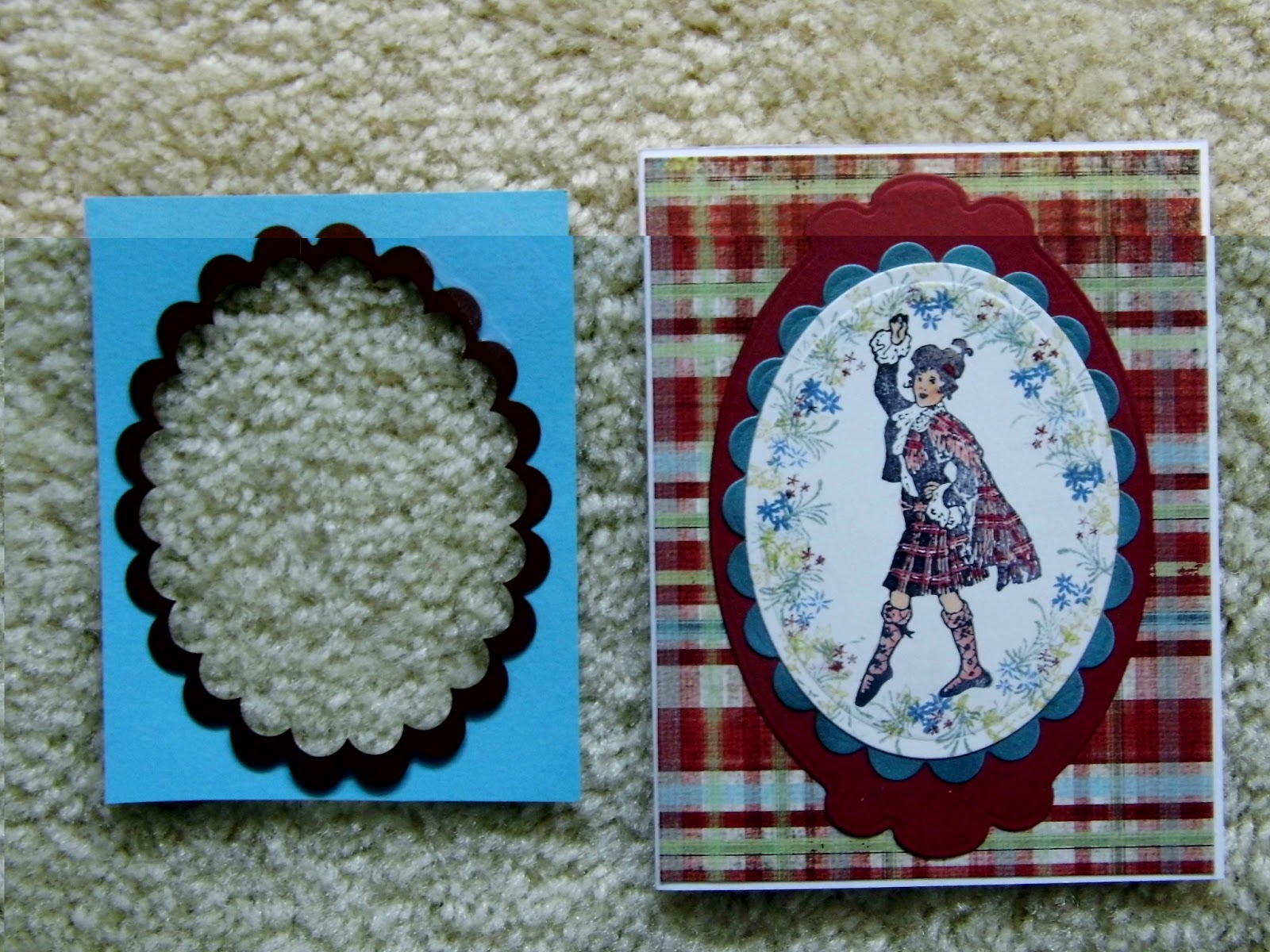
The stamp featured on this card is from Highlander Celtic Stamps. This vintage dancer is encircled in a wreath of Rubber Stamp Tapestry Flowers.  The bagpipes are sounding as her tartan scarf flows in the breeze of her twirls.  She is stamped with Ranger Archival Ink.
The Cardstock is Cryogen available from CutCardstock.com.  I began by cutting an oval shape using a Spellbinders diecut on my Sizzix Big Kick.


The Rubber Stamp Tapestry flowers were stamped in an oval shape using Ranger Distress Inks.  The easiest way I have found to do this is to start with one flower at North, South, East and West and then filling in the gaps around the edge following the oval shape.  Use the Stamping off technique to stamp one dark flower and then stamp another without re-inking.  This gives the same effect as "filler" flowers in a flower arrangement.  A little lighter color is gained which acts as a background to the wreath.
Copic Markers were used to color the clothing and face.  


I love this plaid!  Did, I tell you....I LOVE this plaid!  It is actually a Christmas paper from My Mind's Eye in their "the merry days of Christmas" paper line, called Pajama Plaid

Counting the card itself, there are two background layers and then three matting layers in this card.  The dancer layer and matting are all Spellbinders die cuts.  The dark red layer is cut with Labels 10.


The last embellishment to be added are the three vintage pearls.
Thanks for stopping by.  Bobb, Bobb, Bobbing along until next time.

Sunday, May 26, 2013

Knowing Your Purpose, A Missionary Heart

When James Calvert went out as a missionary to the cannibals of the Fiji Islands, the ship captain tried to turn him back saying, "you will lose your lives and the lives of those with you if you go among such savages".  To that Calvert replied, "We died before we came here."

Sometimes, I forget what I am about and it takes a little jolt of perspective to realign my thinking with God's Word.  I like this quote for it helps me regain my perspective as to what is important and what I should be doing with myself.

I also like to remind myself of the dedication of Caspar Ten Boom.  Corrie Ten Boom's father.  Part of his story is related below.  This version is from Wikipedia, but I originally read it in one of Corrie Ten Boom's books.


The ten Boom family were devout and generous Christians. According to The Hiding Place, in 1918 the family took in the first of many foster children that they would shelter over the years. Corrie ran special church services for disabled children for 20 years. The Dutch Reformed Church "protested Nazi persecution of Jews as an injustice to fellow human beings and an affront to divine authority."[3] The ten Boom family strongly believed that people were equal before God.
During the Nazi occupation of the Netherlands, ten Boom and his daughters became active in sheltering Jewish people who were trying to escape the Nazis at their home. In May 1942, a woman came to the house and asked for help. She said she was a Jew, that her husband had been arrested several months before, and her son had gone into hiding. As Occupation authorities had visited her, she was afraid to return home. She had heard that the family had helped other Jews, and asked if she could stay with them; to which Casper agreed. He believed that all people were equal before God and told her, "In this household, God's people are always welcome." When the Nazis began requiring all Jews to wear the Star of David, he voluntarily wore one also.[4] His son Willem, a minister in the Dutch Reformed Church, also worked in an non-denominational nursing home. During the occupation, he sheltered many Jews there to save them from the Nazis.[3]
Arrest and death [edit]

On 28 February 1944 the Gestapo raided his house and arrested ten Boom and his daughters, as well his son Willem and third daughter, and a nephew, who were visiting. The Gestapo arrested other supporters who visited the house during the day, taking a total of about 30 people to Scheveningen prison.[3]
When ten Boom was interrogated in prison, the Gestapo told him they would release him because of his age so that he could "die in his own bed". He replied: "If I go home today, tomorrow I will open my door to anyone who knocks for help".[4] When asked if he knew he could die for helping Jews, he replied, "It would be an honor to give my life for God's chosen people."[2] On 10 March Casper died at the Hague Municipal Hospital, at the age of 84, after ten days in Scheveningen prison.
His daughter Betsie died at Ravensbruck in December 1944. His son Willem contracted spinal tuberculosis (TB) while imprisoned for his resistance work. Although he was released, he died of TB shortly after the war. Ten Boom's nephew Christiaan, then 24, was sent to the Bergen Belsen concentration camp for his work in the underground, and died there during the war.[2]

Thursday, May 2, 2013

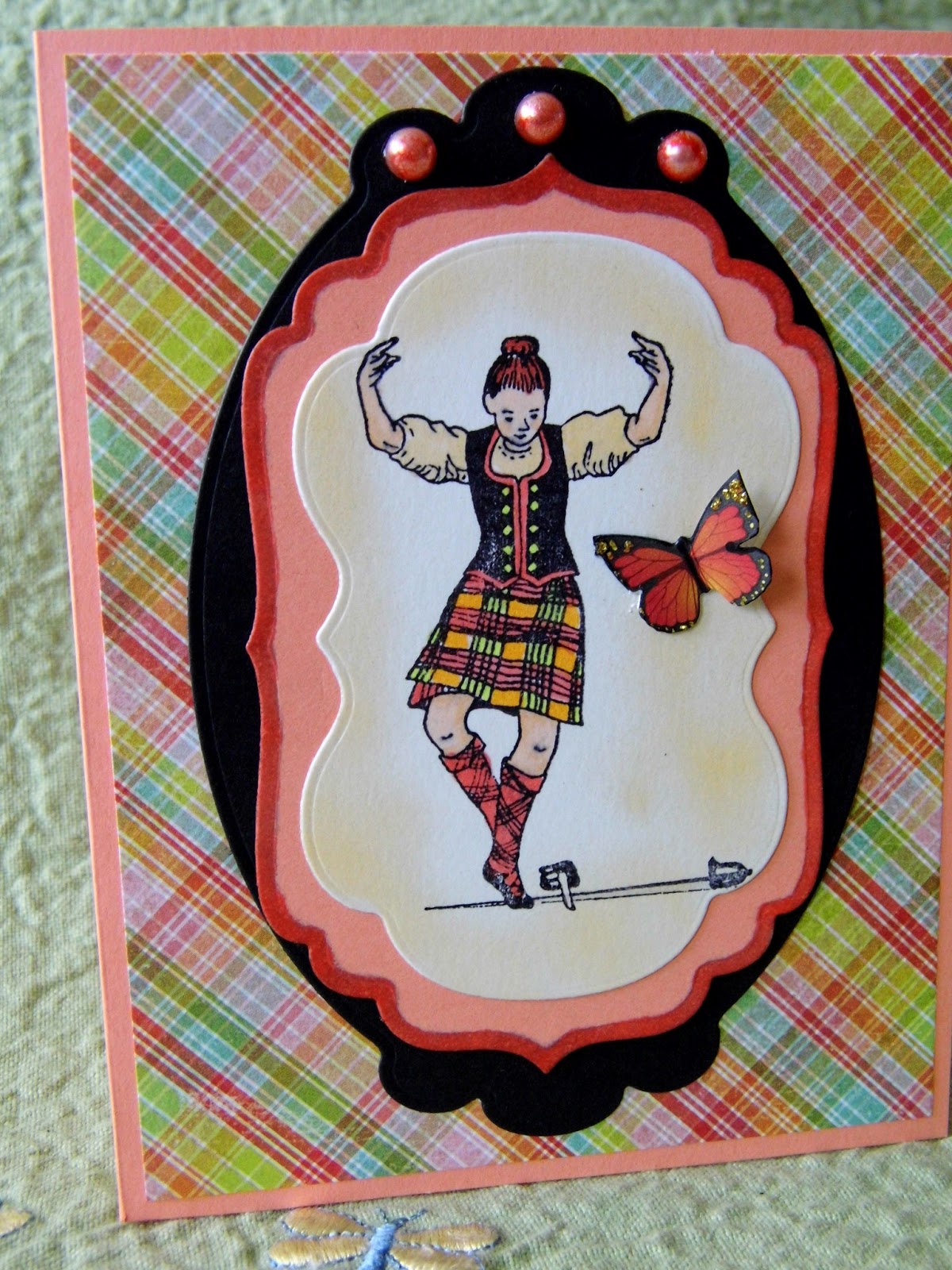
A Scottish Highland Dancer from Highlander Celtic Stamps adorns this colorful plaid background card.

MAY 3, 2013

The upper stamped layer is cut with a  Spellbinders frame, stamped and then colors added with Copic Markers.  I used markers to color the dancer and airbrushing techniques for the background.


A Martha Stewart butterfly dimensional out was added.
The second layer is a coral cardstock cut with Spellbinders Die cut.

The coral die cut was place on yet another Spellbinder cut out in black.

A frame of  color was added to the coral layer with a Copic marker and white pearls airbrushed with Copic Markers were place at the top.


Friday, April 26, 2013

BagPiper''s Salute!

Today's card features the Bagpiper from Highlander Celtic Stamps

He is stamped with Rangers Archival ink and colored with Copic Markers and an Airbrushed background.

The background is from the Spellbinders Die set of Fleur De Lis Rectangles.  I placed the frame over red cardstock of the same size.


I cut corners from the black and then snipped the fleur  de lis from them and placed it on a punched out red circle.  This was actually a very quick card to make.  
Hmmmm. The bloggers challenge with Lisa Black is a black and white wish a splash of color.  Perfect!  Check it out at: Bloggers Challenge with Lisa Black!

Sunday, April 21, 2013

A Highlander Family Pioneer for Highlander Celtic Stamps

Pioneers are US.  I realized one day, that my family and I are pioneers.  We may not be the first wagon in the train, but when the wagons circle up at the end of the day, the Bobb's are there cooking up stew with their friends excitedly discussing the day's advancement on the forefront of the current adventure.

When I started my family tree research, I was one of a very lonely group of people.  I read books to learn how to do research It was before the movie "Roots".  Before the internet and before Ancestry.com.   The first step in any family tree research is to get forms.  An experienced researcher told me forms tell you two things, what you have and what you don't have.  I soon learned that this meant the forms tell you where the next step of your research should be aimed.   If I wanted to look at a census record I went to my local library looked in a book to find the name of the microfilm roll, paid my three dollars and waited three weeks for the microfilms to arrive.  Then I went to the library and spent hours pouring over illegible scribbles of census records and hand wrote my findings.  I tramped through cemeteries with mosquitoes and snakes and took rubbings of headstones.

I was in my early twenties and I would attend genealogy society meetings at local libraries and I would come away chuckling to myself as I was the only person there without gray hair!  

I was not very informed about history or the migratory paths that built the map of the United States.  My maiden name is Stewart, but I only knew that I had an Appalachian Heritage.  We had no family traditions or stories of where our family lived before they came to the mountains of North Carolina.  We had no recipes that pointed to some spot of origin in Europe.  Our religious customs nor any other family lore led anywhere except to the mountains.  


  After many years of this laborious work, I had names back to the 1760 era of colonial North Carolina.  Other than that,  I learned that this area of the United States was rich in Scottish and Scot-Irish immigrants who lived with a few French, Germans, English, Wales and Hollanders and that these immigrant Scots had very close ties to the Native American Cherokee who lived in the same area with them.  Twenty years of researching names, birth dates, marriages, military records, death dates places and burials and I was still not out of the North Carolina mountains.

Part of being a pioneer, is that your goal is not always visible or within reach.  You have a general idea where you want to go, but the details are fuzzy.  This means that it takes a certain amount of faith because uncertainty is your companion.  


I had heard that genetic scientists had used DNA to determine if Jefferson was father to the children of one of his slaves.  this was the first time to my knowledge that DNA was used to declare a relationship and I was fascinated.  If DNA could tell us this, then it could also tell me which of those Stewart families in North Carolina were our kin.  I had been chasing the paper trail of about a half dozen families for years and finally there was some scientific help to a puzzle that hitherto could only be solved by finding rare and sometimes illusive documents.

It took two years, but I found Family Tree DNA and in 2002 pioneered a new adventure.  I began  Family Tree DNA projects for several of my family surnames.  I quickly contacted other researchers that I knew were asking the same questions about our families and enlisted them in our project.

This wagon train was fascinating.  Much as the earlier wagon trains brought together many different cultures, the DNA projects brought together two very different kinds of researchers....those family tree hobbyists, like myself, who were interested in the historical period that contained surnames, and those who researched from an anthropological aspect.  Of course both of those researchers were introduced to the genetic genealogists. I think one of the most fun things about the synergy that resulted from the merging of these societies was the language.  There simply weren't  words yet defined to describe the functionality and logic of what we were experiencing.  So we began coming up with our own definitions and descriptions of new words.  Charles Kerchner published a dictionary of all of our words and my name is beside two words that I coined.  You can see my review of his dictionary here http://archiver.rootsweb.ancestry.com/th/read/GENEALOGY-DNA/2005-01/1104889974 And you can see the dictionary Here http://www.kerchner.com/books/ggdictionary.htm


I started the project to answer a few simple questions about my personal family, but realized very quickly that these projects would carry worldwide significance   Participants in the projects grew and soon Family Tree DNA had thousands of tests to use as references from all over the world.  Then National Geographic got involved and the numbers just kept increasing.


The DNA projects have been a lot of fun and I am still enjoying the type of research that they offer.  As far as my own personal family data, I have learned on a scientific level if not a documentary level, that we ARE of Scottish origin.  And that brings me to the reason for this post!!

Knowing now that we do have a Scottish heritage, the history of Scotland has become very interesting to me.  My next few posts will feature cards with a Scottish theme made from rubber stamps from Highlander Celtic Stamps.  I hope you enjoy!