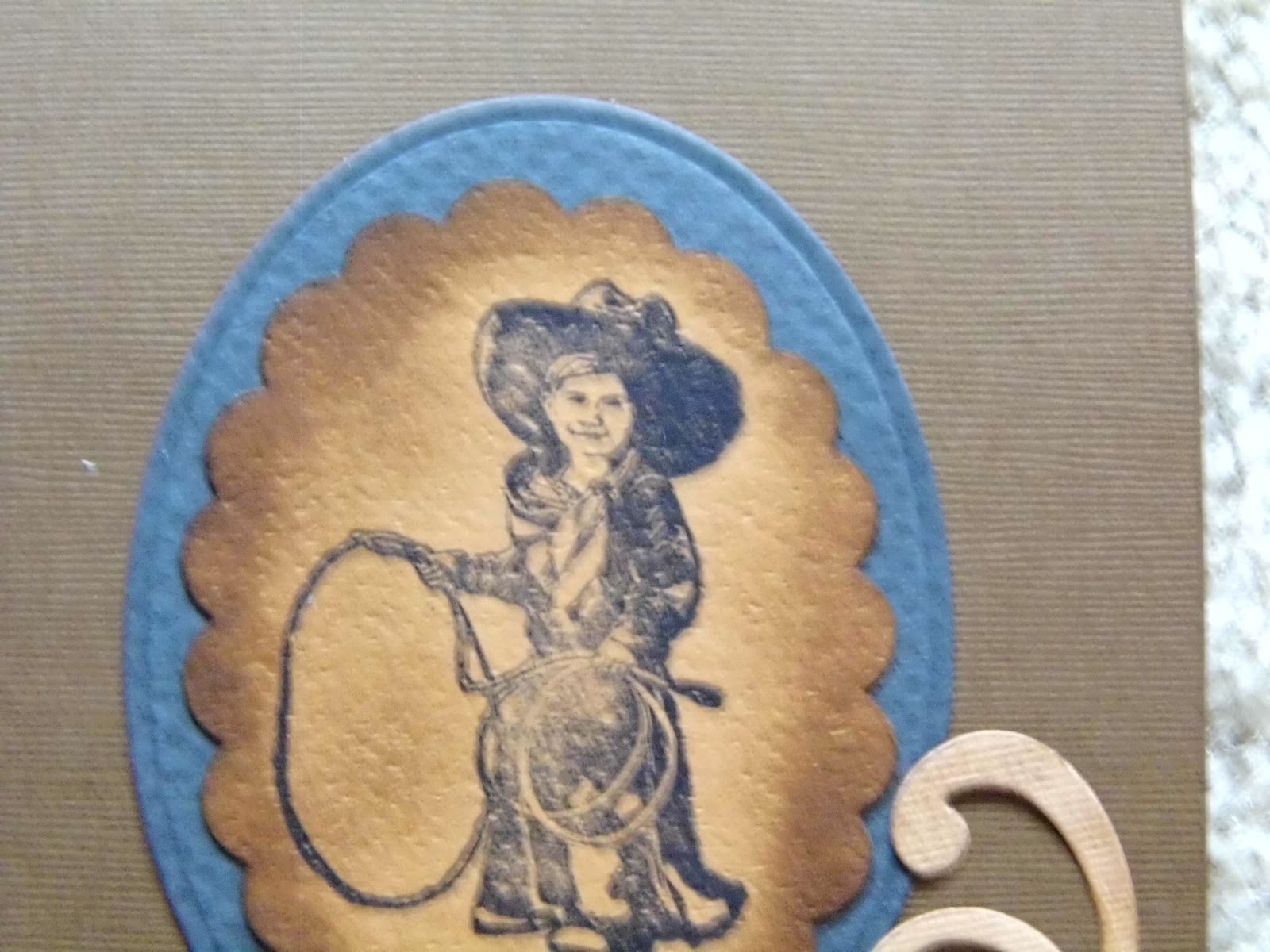
| I picked up the dimensional embellishments at Joanns. I'm not sue what the brand is. |
Showing posts with label Rubber Stamps. Show all posts
Thursday, May 14, 2015
Flippin for Flip-its!These
Sunday, July 21, 2013
HOWDY BIRTHDAY! SURPRISE!
I also have difficulty with blurred images that I can't ever seem to correct. Maybe I will try a tripod next time. I would have taken these again, but I had already given the card away!!!! So, I apologize if your eyes are going crossed looking at my pictures.
This is what the Sizzix Pop N Cut die looks like. It is shown with (left) and without (right) the magnetic insert. There are other inserts that are made for this basic die. The card below is the card opened with the outside showing.
There are two cuts with the Pop N Cut die for this card. The first is the length of the card that has the cut outs of the label that the horse is attached. This becomes the inside of the card and was cut with the flowered paper.
The second cut was of coffee brown card stock and it becomes the outside. This was a quick and easy way to make a pop up card. I'm pleased with this purchase and hope to add some of the additional magnetic dies that are available.
| Punch and die cut ovals used for the background of the little cowpoke. |
| The little cowpoke vignette is framed by smudging the outside of the oval with ink and daubers as pictured. |
| EK Success punches are used for mounting the horse onto the pop up. |
| The sentiment is die cut with a Spellbinders die. |
Sunday, April 21, 2013
A Highlander Family Pioneer for Highlander Celtic Stamps
Pioneers are US. I realized one day, that my family and I are pioneers. We may not be the first wagon in the train, but when the wagons circle up at the end of the day, the Bobb's are there cooking up stew with their friends excitedly discussing the day's advancement on the forefront of the current adventure.
When I started my family tree research, I was one of a very lonely group of people. I read books to learn how to do research It was before the movie "Roots". Before the internet and before Ancestry.com. The first step in any family tree research is to get forms. An experienced researcher told me forms tell you two things, what you have and what you don't have. I soon learned that this meant the forms tell you where the next step of your research should be aimed. If I wanted to look at a census record I went to my local library looked in a book to find the name of the microfilm roll, paid my three dollars and waited three weeks for the microfilms to arrive. Then I went to the library and spent hours pouring over illegible scribbles of census records and hand wrote my findings. I tramped through cemeteries with mosquitoes and snakes and took rubbings of headstones.
I was in my early twenties and I would attend genealogy society meetings at local libraries and I would come away chuckling to myself as I was the only person there without gray hair!
I was not very informed about history or the migratory paths that built the map of the United States. My maiden name is Stewart, but I only knew that I had an Appalachian Heritage. We had no family traditions or stories of where our family lived before they came to the mountains of North Carolina. We had no recipes that pointed to some spot of origin in Europe. Our religious customs nor any other family lore led anywhere except to the mountains.
After many years of this laborious work, I had names back to the 1760 era of colonial North Carolina. Other than that, I learned that this area of the United States was rich in Scottish and Scot-Irish immigrants who lived with a few French, Germans, English, Wales and Hollanders and that these immigrant Scots had very close ties to the Native American Cherokee who lived in the same area with them. Twenty years of researching names, birth dates, marriages, military records, death dates places and burials and I was still not out of the North Carolina mountains.
Part of being a pioneer, is that your goal is not always visible or within reach. You have a general idea where you want to go, but the details are fuzzy. This means that it takes a certain amount of faith because uncertainty is your companion.
I had heard that genetic scientists had used DNA to determine if Jefferson was father to the children of one of his slaves. this was the first time to my knowledge that DNA was used to declare a relationship and I was fascinated. If DNA could tell us this, then it could also tell me which of those Stewart families in North Carolina were our kin. I had been chasing the paper trail of about a half dozen families for years and finally there was some scientific help to a puzzle that hitherto could only be solved by finding rare and sometimes illusive documents.
It took two years, but I found Family Tree DNA and in 2002 pioneered a new adventure. I began Family Tree DNA projects for several of my family surnames. I quickly contacted other researchers that I knew were asking the same questions about our families and enlisted them in our project.
This wagon train was fascinating. Much as the earlier wagon trains brought together many different cultures, the DNA projects brought together two very different kinds of researchers....those family tree hobbyists, like myself, who were interested in the historical period that contained surnames, and those who researched from an anthropological aspect. Of course both of those researchers were introduced to the genetic genealogists. I think one of the most fun things about the synergy that resulted from the merging of these societies was the language. There simply weren't words yet defined to describe the functionality and logic of what we were experiencing. So we began coming up with our own definitions and descriptions of new words. Charles Kerchner published a dictionary of all of our words and my name is beside two words that I coined. You can see my review of his dictionary here http://archiver.rootsweb.ancestry.com/th/read/GENEALOGY-DNA/2005-01/1104889974 And you can see the dictionary Here http://www.kerchner.com/books/ggdictionary.htm
I started the project to answer a few simple questions about my personal family, but realized very quickly that these projects would carry worldwide significance Participants in the projects grew and soon Family Tree DNA had thousands of tests to use as references from all over the world. Then National Geographic got involved and the numbers just kept increasing.
The DNA projects have been a lot of fun and I am still enjoying the type of research that they offer. As far as my own personal family data, I have learned on a scientific level if not a documentary level, that we ARE of Scottish origin. And that brings me to the reason for this post!!
Knowing now that we do have a Scottish heritage, the history of Scotland has become very interesting to me. My next few posts will feature cards with a Scottish theme made from rubber stamps from Highlander Celtic Stamps. I hope you enjoy!
When I started my family tree research, I was one of a very lonely group of people. I read books to learn how to do research It was before the movie "Roots". Before the internet and before Ancestry.com. The first step in any family tree research is to get forms. An experienced researcher told me forms tell you two things, what you have and what you don't have. I soon learned that this meant the forms tell you where the next step of your research should be aimed. If I wanted to look at a census record I went to my local library looked in a book to find the name of the microfilm roll, paid my three dollars and waited three weeks for the microfilms to arrive. Then I went to the library and spent hours pouring over illegible scribbles of census records and hand wrote my findings. I tramped through cemeteries with mosquitoes and snakes and took rubbings of headstones.
I was in my early twenties and I would attend genealogy society meetings at local libraries and I would come away chuckling to myself as I was the only person there without gray hair!
I was not very informed about history or the migratory paths that built the map of the United States. My maiden name is Stewart, but I only knew that I had an Appalachian Heritage. We had no family traditions or stories of where our family lived before they came to the mountains of North Carolina. We had no recipes that pointed to some spot of origin in Europe. Our religious customs nor any other family lore led anywhere except to the mountains.
After many years of this laborious work, I had names back to the 1760 era of colonial North Carolina. Other than that, I learned that this area of the United States was rich in Scottish and Scot-Irish immigrants who lived with a few French, Germans, English, Wales and Hollanders and that these immigrant Scots had very close ties to the Native American Cherokee who lived in the same area with them. Twenty years of researching names, birth dates, marriages, military records, death dates places and burials and I was still not out of the North Carolina mountains.
Part of being a pioneer, is that your goal is not always visible or within reach. You have a general idea where you want to go, but the details are fuzzy. This means that it takes a certain amount of faith because uncertainty is your companion.
I had heard that genetic scientists had used DNA to determine if Jefferson was father to the children of one of his slaves. this was the first time to my knowledge that DNA was used to declare a relationship and I was fascinated. If DNA could tell us this, then it could also tell me which of those Stewart families in North Carolina were our kin. I had been chasing the paper trail of about a half dozen families for years and finally there was some scientific help to a puzzle that hitherto could only be solved by finding rare and sometimes illusive documents.
It took two years, but I found Family Tree DNA and in 2002 pioneered a new adventure. I began Family Tree DNA projects for several of my family surnames. I quickly contacted other researchers that I knew were asking the same questions about our families and enlisted them in our project.
This wagon train was fascinating. Much as the earlier wagon trains brought together many different cultures, the DNA projects brought together two very different kinds of researchers....those family tree hobbyists, like myself, who were interested in the historical period that contained surnames, and those who researched from an anthropological aspect. Of course both of those researchers were introduced to the genetic genealogists. I think one of the most fun things about the synergy that resulted from the merging of these societies was the language. There simply weren't words yet defined to describe the functionality and logic of what we were experiencing. So we began coming up with our own definitions and descriptions of new words. Charles Kerchner published a dictionary of all of our words and my name is beside two words that I coined. You can see my review of his dictionary here http://archiver.rootsweb.ancestry.com/th/read/GENEALOGY-DNA/2005-01/1104889974 And you can see the dictionary Here http://www.kerchner.com/books/ggdictionary.htm
I started the project to answer a few simple questions about my personal family, but realized very quickly that these projects would carry worldwide significance Participants in the projects grew and soon Family Tree DNA had thousands of tests to use as references from all over the world. Then National Geographic got involved and the numbers just kept increasing.
The DNA projects have been a lot of fun and I am still enjoying the type of research that they offer. As far as my own personal family data, I have learned on a scientific level if not a documentary level, that we ARE of Scottish origin. And that brings me to the reason for this post!!
Knowing now that we do have a Scottish heritage, the history of Scotland has become very interesting to me. My next few posts will feature cards with a Scottish theme made from rubber stamps from Highlander Celtic Stamps. I hope you enjoy!
Wednesday, May 4, 2011
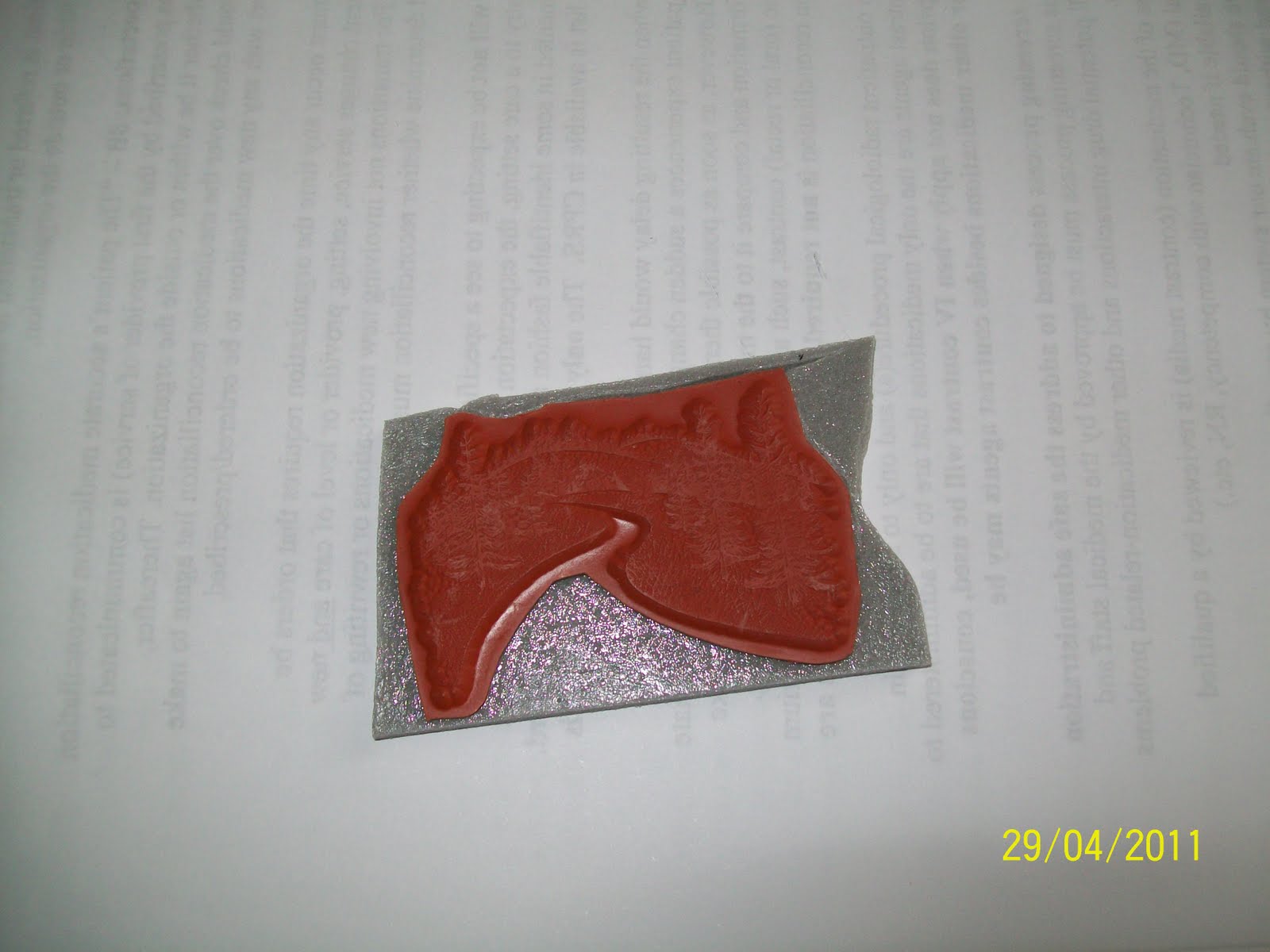
Mounting Rubber Stamps on EZ Mount Stamp N Stor
Rubber Stamping has changed in the 6 or 8 years since I started. Wood handled stamps are fast giving way to either clear stamps or traditional (usually red, but can be other colors) rubber stamps that can be mounted on clear plastic blocks (or any slick surface, I have even used a drinking glass as a block). The beauty of the clear block is that you can see through it a little better for your stamp placement.
They are also easier to store AND easier on the pocket book! The downside is that I tend to buy unmounteds and not get them mounted until I perform my annual evening of sitting down and mounting all the stamps that I bought this year. I kind of lose the momentum of inspiration that I had when I purchased the stamp if I don't use it shortly after I purchase it. However, due to the dollar savings I foresee many unmounteds in my future. I decided to show you how I mount them today with a few pictures. I use a hot knife. They can be purchase at any craft store. Be warned however that these things get really hot!!!!
I have used mine several times, but this past week I managed to burn myself
1. Assemble the knife.
2. Plug in the knife and let it heat up on its wire stand.
3. Place a self healing mat or several layers of paper or something that will keep the knife from scratching the work surface.
4. Trim your rubber close to the edge of the imprint.
5. Peel back the sticky adhesive side of the EZ Mount paper and place your stamps on the foam. Blank side of the stamp to the adhesive side of the foam.
6. On the other side of the foam, peel the white paper backing off of the foam. Slicing will be much easier as you are cutting through the foam without the attached white paper.
7. Begin slicing around the edge of the unmounted stamp.
They are also easier to store AND easier on the pocket book! The downside is that I tend to buy unmounteds and not get them mounted until I perform my annual evening of sitting down and mounting all the stamps that I bought this year. I kind of lose the momentum of inspiration that I had when I purchased the stamp if I don't use it shortly after I purchase it. However, due to the dollar savings I foresee many unmounteds in my future. I decided to show you how I mount them today with a few pictures. I use a hot knife. They can be purchase at any craft store. Be warned however that these things get really hot!!!!
I have used mine several times, but this past week I managed to burn myself
1. Assemble the knife.
2. Plug in the knife and let it heat up on its wire stand.
3. Place a self healing mat or several layers of paper or something that will keep the knife from scratching the work surface.
4. Trim your rubber close to the edge of the imprint.
5. Peel back the sticky adhesive side of the EZ Mount paper and place your stamps on the foam. Blank side of the stamp to the adhesive side of the foam.
6. On the other side of the foam, peel the white paper backing off of the foam. Slicing will be much easier as you are cutting through the foam without the attached white paper.
7. Begin slicing around the edge of the unmounted stamp.
Sunday, June 13, 2010
I have been on several excursions in the past couple of months some of which included a short jaunt to Dayton Ohio and another longer trip to Schaumburg Il. Of course when I travel I check out the local craft suppliers for Rubber Stamps, Cardstock and unusual items of interest.
While in Dayton, I made my first trip to Marco's Paper in the Kettering/Dayton area. I was interested in purchasing some Nina cardstock to use with the Copic markers alcohol ink.
Upon entering the store, I was pleasantly greeted by a display of Tweety Jill's Rubber Stamp Collection by TJ Designs. These are deeply etched red rubber stamps mounted on cling foam and made to use with acrylic blocks. These collections are sets of themed rubber stamps in clear cases. There are coordinating designed paper for each theme. The colors in these designs took my breath away. They are beautiful.
While on the Schaumburg trip I had a lot of free time in the evenings. I was very blessed on this trip as I was able to stay in a large room. The room was able to accomodate two banquet luncheon tables. I brought my stamping materials with me and so I was able to spend every evening and two weekends creating cards!
Labels:
American Crafts,
Card,
chicken,
Copic Markers Airbrushing,
Encouragement,
handmade,
Hero Arts,
K and Company,
rooster,
Rubber Stamps,
sending sunshine,
Stampscapes,
TJ Designs,
Tweety Jill
Subscribe to:
Posts (Atom)